Home › Aves › Picidae › Pileated Woodpecker (Dryocopus pileatus)
SPECIES PROFILE
Pileated Woodpecker (Dryocopus pileatus)
Dryocopus
IUCN STATUS
Least Concern

CONSERVATION STATUS
Least Concern
CLASS
Aves
GEOGRAPHICAL RANGE
Mature forest across much of North America from the Pacific Northwest to Florida and northeastern Canada
DIET
Carnivore
HABITAT
Mature and old-growth forests with large dead trees (snags) and fallen logs; requires territories of 50–200 hectares
🔬 Classification
PHYLUM
Chordata
CLASS
Aves
ORDER
Piciformes
FAMILY
Picidae
GENUS
Dryocopus
📋 Description
SIZE
40–49 cm; 250–350 g; the largest woodpecker in North America
COLORATION
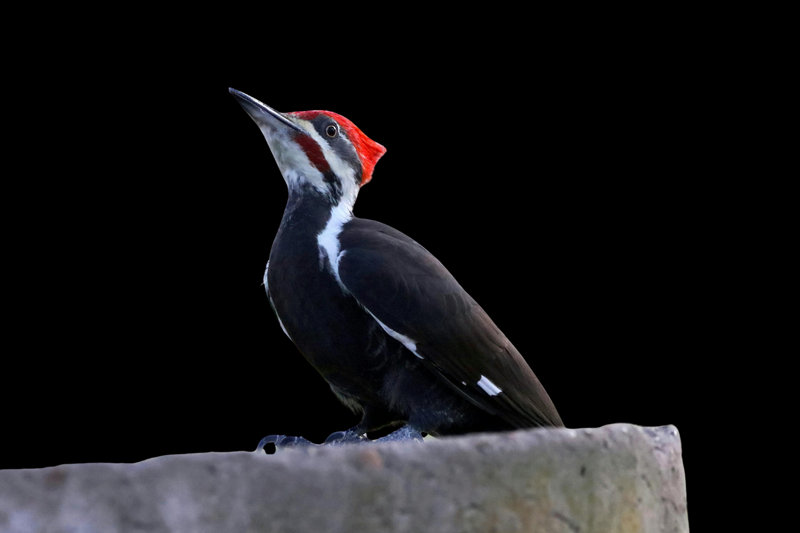
Glossy black body with a brilliant red crest; white stripes on the neck and face; white underwing patches visible in flight
ADAPTATIONS
Powerful chisel-like bill for excavating deep rectangular cavities in dead wood to access carpenter ant colonies; long sticky tongue
🌿 Ecology
HABITAT
Mature and old-growth forests with large dead trees (snags) and fallen logs; requires territories of 50–200 hectares
DIET
Carnivore
GEOGRAPHIC RANGE
Mature forest across much of North America from the Pacific Northwest to Florida and northeastern Canada
REPRODUCTION
Monogamous pair excavates a new nest cavity each year in a large dead tree; 3–5 eggs; both parents incubate for 18 days
DIET DETAILS
Carpenter ants are the primary prey making up over 60% of the diet; also beetle larvae, termites, and wild berries
⚠️ Threats & Conservation
PRIMARY THREATS
Loss of old-growth forest and large snags; logging removing dead trees required for nesting
💡 Interesting Facts
1
The Pileated Woodpecker excavates large rectangular holes — sometimes 50 cm deep — in pursuit of carpenter ant colonies; these cavities are later used by owls, ducks, and small mammals.
2
The Pileated Woodpecker is thought to be the inspiration for the Woody Woodpecker cartoon character; its call is also the quintessential "jungle bird" sound used in movies.
🔭 Sighting Guide
📍 BEST PLACES TO SIGHT
Olympic National Park near the Hoh Visitor Center, WA, has resident Pileated Woodpeckers in old-growth forest
Redwood National and State Parks near Orick, CA, has Pileated Woodpeckers in ancient redwood groves
Mount Hood National Forest near Portland, OR, has Pileated Woodpeckers in mature Douglas-fir stands
🗓️ BEST TIME TO SIGHT
Year-round in old-growth Douglas-fir and cedar forests; Olympic National Park and Redwood National Park are reliable sites in the Pacific Northwest.
🎯 SIGHTING TIPS
Year-round. Listen for loud drumming and kek-kek calls in old-growth and mature forests; excavated rectangular holes reveal presence.