Home › Aves › Cathartidae › California Condor (Gymnogyps californianus)
SPECIES PROFILE
California Condor (Gymnogyps californianus)
Gymnogyps
IUCN STATUS
Critically Endangered


CONSERVATION STATUS
Critically Endangered
CLASS
Aves
GEOGRAPHICAL RANGE
Reintroduced to coastal California, Arizona-Utah border, Baja California, and the Sierra Nevada from captive breeding programmes
DIET
Scavenger
HABITAT
Open chaparral, savanna, conifer forest, and rocky cliff faces used for roosting and nesting; wide foraging range up to 250 km per day
🔬 Classification
PHYLUM
Chordata
CLASS
Aves
ORDER
Cathartiformes
FAMILY
Cathartidae
GENUS
Gymnogyps
📋 Description
SIZE
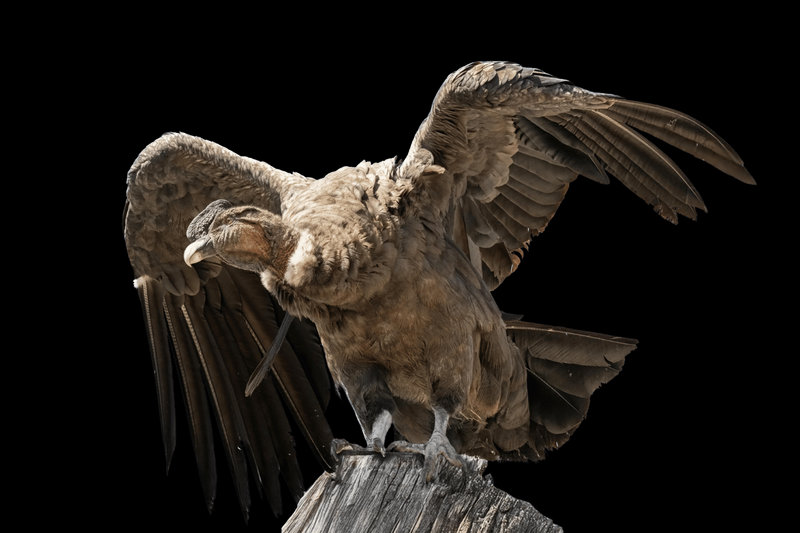
Body 109–140 cm; wingspan up to 3 m; weight 7–11 kg — the largest land bird in North America
COLORATION
Jet black with white underwing triangles and a bare orange-red head that flushes deeper during social interactions
ADAPTATIONS
Keen eyesight for locating distant carcasses; soars effortlessly on thermals; bald head prevents food-fouling during carrion feeding
🌿 Ecology
HABITAT
Open chaparral, savanna, conifer forest, and rocky cliff faces used for roosting and nesting; wide foraging range up to 250 km per day
DIET
Scavenger
GEOGRAPHIC RANGE
Reintroduced to coastal California, Arizona-Utah border, Baja California, and the Sierra Nevada from captive breeding programmes
REPRODUCTION
One of the slowest reproducing birds — lays a single egg every 2 years; both parents incubate for 57 days; chick dependent for 1 year
DIET DETAILS
Exclusively carrion — large mammal carcasses including deer, cattle, and marine mammals; also feeds on smaller carcasses opportunistically
⚠️ Threats & Conservation
PRIMARY THREATS
Lead poisoning from ingested bullet fragments in carcasses is the primary threat; also microtrash fed to chicks; power line collisions
💡 Interesting Facts
1
The California Condor was reduced to just 27 individuals in 1987 when the entire wild population was captured for captive breeding; the wild population now exceeds 300.
2
Condors can soar over 250 km per day without flapping and reach altitudes of 4,500 m; their 3-metre wingspan is the largest of any North American bird.
🔭 Sighting Guide
📍 BEST PLACES TO SIGHT
Pinnacles National Park near Hollister, CA, has one of the most reliable wild California Condor populations for viewing
Grand Canyon South Rim near Tusayan, AZ, has California Condors roosting and soaring near Desert View
Zion National Park near Springdale, UT, has California Condors soaring over the canyon cliffs
🗓️ BEST TIME TO SIGHT
Year-round at Pinnacles National Park, CA, and Grand Canyon South Rim, AZ; condors are tagged and tracked, increasing sighting reliability.
🎯 SIGHTING TIPS
Year-round. Pinnacles National Park and the Grand Canyon South Rim are the most reliable places to see wild California Condors.