Home › Aves › Cuculidae › Greater Roadrunner (Geococcyx californianus)
SPECIES PROFILE
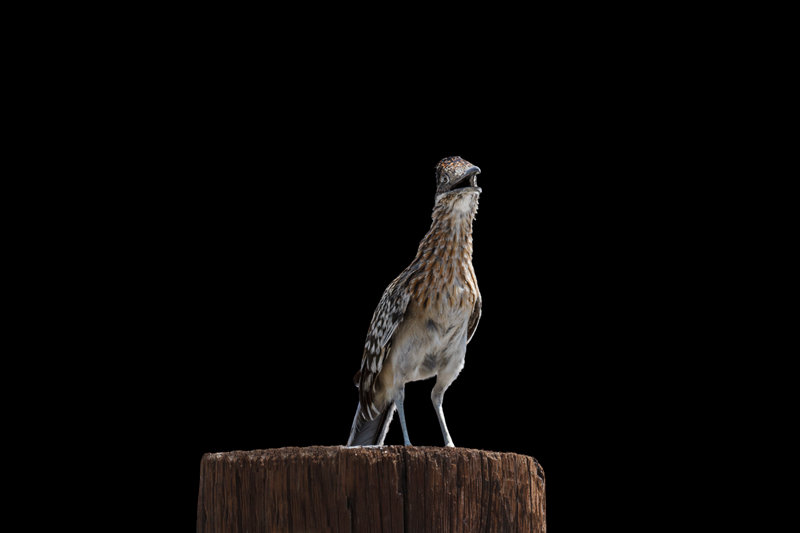
Greater Roadrunner (Geococcyx californianus)
Geococcyx
IUCN STATUS
Least Concern

CONSERVATION STATUS
Least Concern
CLASS
Aves
GEOGRAPHICAL RANGE
Southwestern US from California to Texas, and south through Mexico to Central America
DIET
Carnivore
HABITAT
Desert scrub, chaparral, and open grassland with scattered brush; avoids dense forest; common in suburban areas bordering desert
🔬 Classification
PHYLUM
Chordata
CLASS
Aves
ORDER
Cuculiformes
FAMILY
Cuculidae
GENUS
Geococcyx
📋 Description
SIZE
52–62 cm; 230–430 g
COLORATION
Streaky brown and white above; white below; long tail held horizontal; blue and red bare skin patch behind the eye; shaggy brown crest
ADAPTATIONS
Can run at 32 km/h to capture prey; kills rattlesnakes by pinning the head and slamming it against rocks; uses sunbathing to warm up on cold mornings
🌿 Ecology
HABITAT
Desert scrub, chaparral, and open grassland with scattered brush; avoids dense forest; common in suburban areas bordering desert
DIET
Carnivore
GEOGRAPHIC RANGE
Southwestern US from California to Texas, and south through Mexico to Central America
REPRODUCTION
Monogamous pair; 3–6 eggs in a stick nest in a low shrub; both parents incubate for 20 days; multiple broods per season
DIET DETAILS
Lizards, snakes, scorpions, tarantulas, small birds, rodents, and insects; the diet is strikingly varied for a bird
⚠️ Threats & Conservation
PRIMARY THREATS
Habitat loss from urban development; vehicle mortality; predation by domestic cats and dogs near suburbs
💡 Interesting Facts
1
The Greater Roadrunner, the state bird of New Mexico, can kill and swallow a rattlesnake — it attacks by pinning the head and then battering it against a hard surface.
2
Roadrunners are cuckoos that have evolved to be fully terrestrial; they are capable of short flights but prefer running, reaching speeds of up to 32 km/h on the ground.
🔭 Sighting Guide
📍 BEST PLACES TO SIGHT
Saguaro National Park East near Tucson, AZ, has Greater Roadrunners along desert trails in the morning
Bosque del Apache National Wildlife Refuge near Socorro, NM, has Roadrunners in desert scrub along the wildlife loop
Big Bend National Park near Terlingua, TX, has Greater Roadrunners around the visitor centre and desert trails
🗓️ BEST TIME TO SIGHT
Year-round in Saguaro National Park near Tucson, AZ, and Bosque del Apache NWR in NM; most active in cool morning hours.
🎯 SIGHTING TIPS
Year-round in desert scrub; early morning when active; found walking along desert trails and roadsides throughout the Southwest.