
Home › Aves › Phasianidae › Wild Turkey (Meleagris gallopavo)
SPECIES PROFILE
Wild Turkey (Meleagris gallopavo)
Meleagris
IUCN STATUS
Least Concern

CONSERVATION STATUS
Least Concern
CLASS
Aves
GEOGRAPHICAL RANGE
Widespread across the eastern US and parts of the west after extensive restocking programmes; historically in the Southeast and Midwest
DIET
Omnivore
HABITAT
Mixed forest and forest-edge habitat; woodlands with mast-producing trees (oaks, beeches) for food; open areas for display
🔬 Classification
PHYLUM
Chordata
CLASS
Aves
ORDER
Galliformes
FAMILY
Phasianidae
GENUS
Meleagris
📋 Description
SIZE
Males 5–11 kg; body length up to 1.2 m; females 2.5–5.4 kg
COLORATION
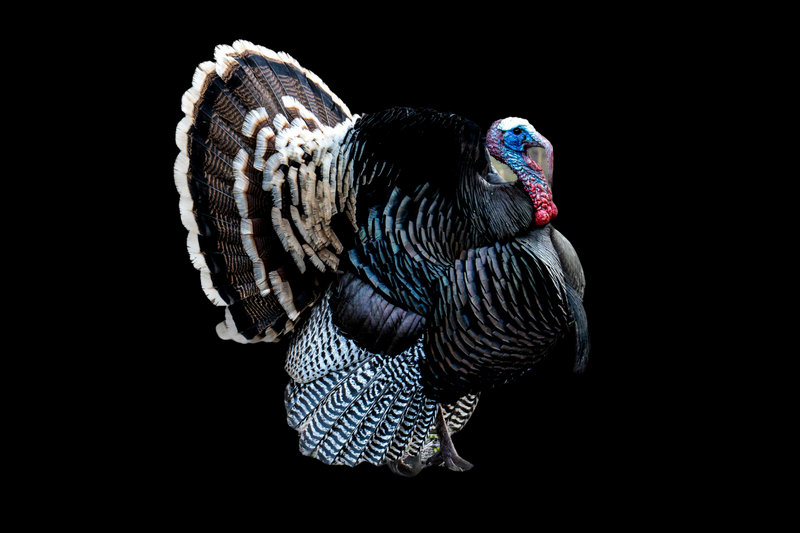
Males: iridescent bronze-green feathers with a bare red and blue head, caruncles, and a dangling snood; females duller brown; fan-shaped tail displayed during courtship
ADAPTATIONS
Outstanding eyesight and colour vision; can run at 40 km/h and fly at 90 km/h in short bursts; roosts in trees to avoid predators
🌿 Ecology
HABITAT
Mixed forest and forest-edge habitat; woodlands with mast-producing trees (oaks, beeches) for food; open areas for display
DIET
Omnivore
GEOGRAPHIC RANGE
Widespread across the eastern US and parts of the west after extensive restocking programmes; historically in the Southeast and Midwest
REPRODUCTION
Polygynous; tom displays to a harem of hens; hen lays 10–15 eggs in a leaf-lined depression; incubates alone for 28 days
DIET DETAILS
Acorns, beechnuts, wild berries, insects, small reptiles, and tubers; scratches leaf litter to expose food
⚠️ Threats & Conservation
PRIMARY THREATS
Over-hunting historically extirpated populations across much of the range; now fully recovered through restocking; hunting is regulated
💡 Interesting Facts
1
The Wild Turkey was Benjamin Franklin's preferred candidate for the national bird of the United States; he considered it "a bird of courage" compared to the "bad moral character" of the Bald Eagle.
2
Wild Turkeys were hunted to local extinction across most of their range by the early 20th century; a concerted restocking effort by state wildlife agencies beginning in the 1940s has made it one of conservation's greatest success stories.
🔭 Sighting Guide
📍 BEST PLACES TO SIGHT
Great Smoky Mountains National Park near Gatlinburg, TN, has Wild Turkeys visible in Cades Cove meadows
Shenandoah National Park near Luray, VA, has Wild Turkeys along Skyline Drive in spring and autumn
Ozark National Forest near Fayetteville, AR, has abundant Wild Turkeys in mixed oak-hickory forest
🗓️ BEST TIME TO SIGHT
Year-round. Breeding season April to May brings strutting males (toms) to forest clearings; Shenandoah and Great Smoky Mountains are reliable.
🎯 SIGHTING TIPS
April and May for breeding displays; year-round in Great Smoky Mountains NP and Shenandoah NP where habituated birds are regularly seen.


