Home › Aves › Phasianidae › Ocellated Turkey (Meleagris ocellata)
SPECIES PROFILE
Ocellated Turkey (Meleagris ocellata)
Meleagris
IUCN STATUS
Near Threatened


CONSERVATION STATUS
Near Threatened
CLASS
Aves
GEOGRAPHICAL RANGE
Endemic to the Yucatan Peninsula of Mexico, Belize, and northern Guatemala; found nowhere else on Earth
DIET
Omnivore
HABITAT
Tropical forest and forest edges of the Yucatan lowlands; requires a mosaic of closed forest for roosting and open areas for foraging
🔬 Classification
PHYLUM
Chordata
CLASS
Aves
ORDER
Galliformes
FAMILY
Phasianidae
GENUS
Meleagris
📋 Description
SIZE
Males 86–94 cm; 4–5 kg; females 60–70 cm; 3 kg
COLORATION
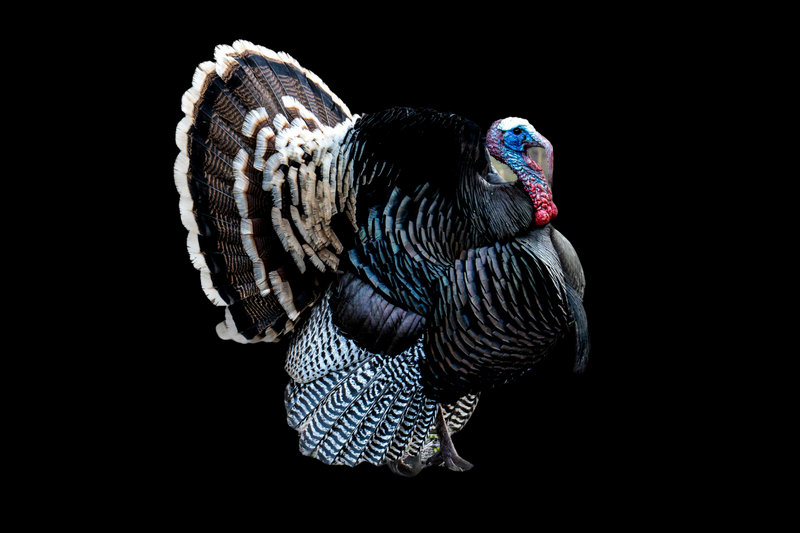
Males: iridescent bronze-green and blue body; bare blue head with orange-red wart-like nodules; blue and orange eye rings; tail adorned with iridescent eye (ocellus) spots; no beard
ADAPTATIONS
Males perform elaborate display with fanned tail showing iridescent eye-spots; loud distinctive gobbling call unlike the Wild Turkey; roosts in trees
🌿 Ecology
HABITAT
Tropical forest and forest edges of the Yucatan lowlands; requires a mosaic of closed forest for roosting and open areas for foraging
DIET
Omnivore
GEOGRAPHIC RANGE
Endemic to the Yucatan Peninsula of Mexico, Belize, and northern Guatemala; found nowhere else on Earth
REPRODUCTION
Female lays 8–15 eggs in a leaf-lined ground scrape; incubates alone for 28 days; poults precocial
DIET DETAILS
Seeds, berries, insects, lizards, and small invertebrates; forages on the ground and in low shrubs
⚠️ Threats & Conservation
PRIMARY THREATS
Hunting for meat and sport; habitat loss from forest clearance; egg collection
💡 Interesting Facts
1
The Ocellated Turkey is endemic to the Yucatan Peninsula and was sacred to the ancient Maya; its iridescent feathers decorated royal costumes and its image appears frequently in Maya art.
2
Despite being in the same genus as the Wild Turkey, the Ocellated Turkey is so distinct that many ornithologists consider it a separate genus; male Ocellated Turkeys lack the beard found on all male Wild Turkeys.
🔭 Sighting Guide
📍 BEST PLACES TO SIGHT
Calakmul ruins and Biosphere Reserve near Xpujil, Campeche, have Ocellated Turkeys foraging around the ancient Maya temples
Sian Ka'an Biosphere Reserve near Tulum, Quintana Roo, has Ocellated Turkeys in dry tropical forest
Ría Lagartos Biosphere Reserve near Río Lagartos, Yucatán, has Ocellated Turkeys in dry forest adjacent to coastal lagoons
🗓️ BEST TIME TO SIGHT
Year-round. Endemic to the Yucatan Peninsula; strutting males display near Calakmul ruins and Sian Ka'an in spring; more colourful than the Wild Turkey.
🎯 SIGHTING TIPS
Year-round near Calakmul ruins and Xpujil, Campeche; March to May for male display behaviour near forest clearings; active in early morning.