Home › Mammalia › Antilocapridae › Pronghorn (Antilocapra americana)
SPECIES PROFILE
Pronghorn (Antilocapra americana)
Antilocapra
IUCN STATUS
Least Concern

CONSERVATION STATUS
Least Concern
CLASS
Mammalia
GEOGRAPHICAL RANGE
Great Plains and intermountain west from southern Canada to Mexico; concentrated in WY, MT, ID, and the Southwest
DIET
Herbivore
HABITAT
Open sagebrush steppe, grasslands, and semi-desert shrublands; avoids dense forest and areas with fences
🔬 Classification
PHYLUM
Chordata
CLASS
Mammalia
ORDER
Artiodactyla
FAMILY
Antilocapridae
GENUS
Antilocapra
📋 Description
SIZE
Males 40–65 kg; females 34–50 kg; body length 1.3–1.5 m
COLORATION
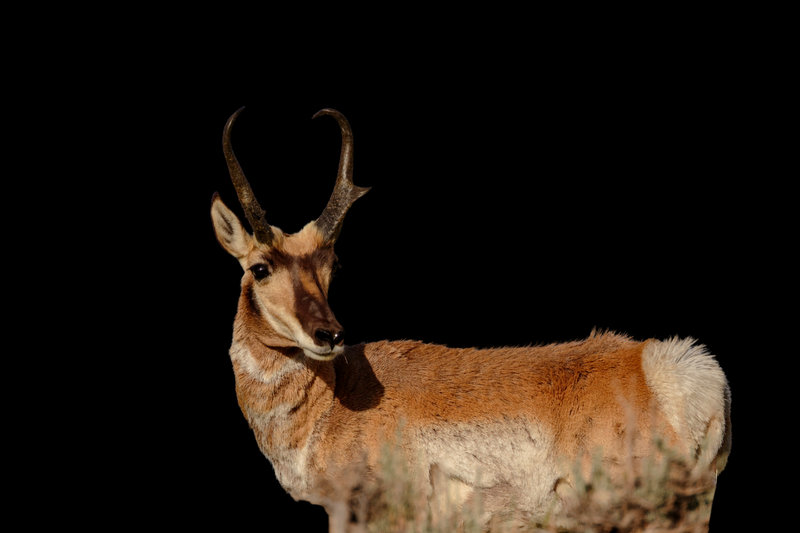
Tan to reddish-brown with white sides and rump; males have black face markings and black-tipped pronged horns shed annually; both sexes have white rump patch
ADAPTATIONS
Largest eyes of any North American ungulate relative to body size; can sustain 88 km/h for several kilometres — the fastest land animal in the Western Hemisphere
🌿 Ecology
HABITAT
Open sagebrush steppe, grasslands, and semi-desert shrublands; avoids dense forest and areas with fences
DIET
Herbivore
GEOGRAPHIC RANGE
Great Plains and intermountain west from southern Canada to Mexico; concentrated in WY, MT, ID, and the Southwest
REPRODUCTION
Rut in September; does typically bear twins in May; fawns spotted at birth; can outrun most predators within days of birth
DIET DETAILS
Sagebrush, grasses, forbs, and cacti; highly selective diet varying seasonally
⚠️ Threats & Conservation
PRIMARY THREATS
Fencing blocking traditional migration routes; habitat fragmentation; drought reducing forage quality
💡 Interesting Facts
1
The Pronghorn is the second-fastest land animal on Earth after the cheetah — capable of 88 km/h and able to sustain 65 km/h for kilometres, an adaptation to outrun now-extinct American cheetahs.
2
The Pronghorn undertakes one of North America's longest land migrations — Wyoming's Path of the Pronghorn is a 300-km corridor where herds travel between summer and winter ranges.
🔭 Sighting Guide
📍 BEST PLACES TO SIGHT
Antelope Flats Road in Grand Teton National Park, WY, has large Pronghorn herds visible from the road in summer
Yellowstone National Park's northern range near Gardiner, MT, has Pronghorn herds in sagebrush flats
Seedskadee National Wildlife Refuge near Green River, WY, is on the Path of the Pronghorn migration corridor
🗓️ BEST TIME TO SIGHT
July to September in Grand Teton National Park around Antelope Flats Road; October for the autumn migration through Wyoming's Path of the Pronghorn.
🎯 SIGHTING TIPS
Year-round on sagebrush flats; summer brings large herds to Grand Teton and Yellowstone; migration south in autumn.
🏨 Where to Stay
🐾 You Might Also Want to See...

Species
Range
Status
Species
Range
Status
Species
Range
Status
Species
Range
Status