Home › Amphibia › Dicamptodontidae › Pacific Giant Salamander (Dicamptodon tenebrosus)
SPECIES PROFILE
Pacific Giant Salamander (Dicamptodon tenebrosus)
Dicamptodon
IUCN STATUS
Least Concern

CONSERVATION STATUS
Least Concern
CLASS
Amphibia
GEOGRAPHICAL RANGE
Coastal mountains and Cascade Range from northern California to southern British Columbia
DIET
Carnivore
HABITAT
Cold, fast-flowing mountain streams and surrounding old-growth forest; larvae fully aquatic; adults amphibious
🔬 Classification
PHYLUM
Chordata
CLASS
Amphibia
ORDER
Caudata
FAMILY
Dicamptodontidae
GENUS
Dicamptodon
📋 Description
SIZE
17–34 cm total length; up to 180 g — one of the largest terrestrial salamanders in North America
COLORATION
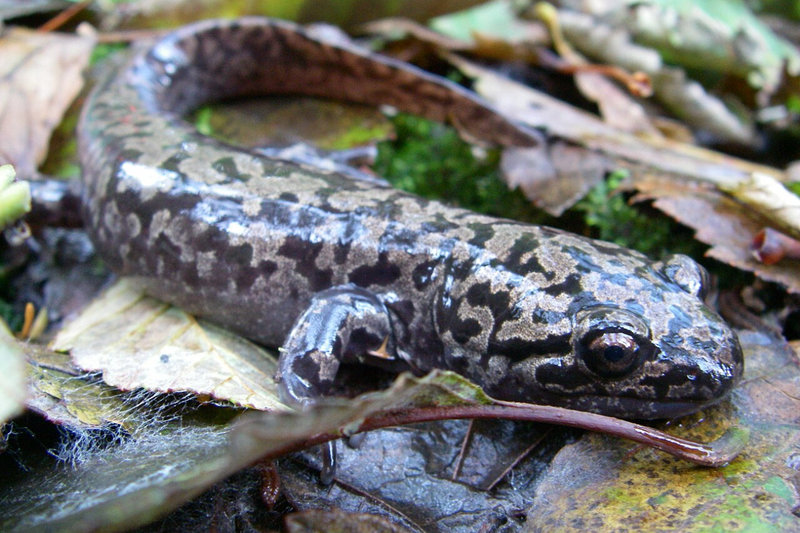
Dark brown or grey with marbled lighter blotches; robust body; broad flat head; moist smooth skin
ADAPTATIONS
Can vocalise — one of very few salamanders to produce a sound (a low bark or rattle when handled); highly aquatic larvae may become permanently neotenic
🌿 Ecology
HABITAT
Cold, fast-flowing mountain streams and surrounding old-growth forest; larvae fully aquatic; adults amphibious
DIET
Carnivore
GEOGRAPHIC RANGE
Coastal mountains and Cascade Range from northern California to southern British Columbia
REPRODUCTION
Eggs laid under rocks in cold streams; female guards eggs until hatching; larvae may metamorphose or remain permanently aquatic (neotenic)
DIET DETAILS
Larvae: aquatic invertebrates and small fish; adults: large invertebrates, small mice, and even small snakes
⚠️ Threats & Conservation
PRIMARY THREATS
Logging of old-growth forests degrading stream quality; siltation of spawning habitat; stream temperature increase
💡 Interesting Facts
1
The Pacific Giant Salamander is one of the few salamanders in the world capable of vocalising — it can produce a low rattling bark when threatened.
2
Some individuals remain permanently in the larval (aquatic) stage their entire lives, a condition called neoteny; others metamorphose into terrestrial adults that may climb trees.
🔭 Sighting Guide
📍 BEST PLACES TO SIGHT
Olympic National Park near the Hoh Rain Forest, WA, has Pacific Giant Salamanders in cold pristine streams
Opal Creek Wilderness near Salem, OR, has old-growth streams with Pacific Giant Salamander populations
Mount Rainier National Park, WA, has Pacific Giant Salamanders in cold Cascade Range mountain streams
🗓️ BEST TIME TO SIGHT
Look under rocks in cold, clear mountain streams in Olympic National Park and the Oregon Cascades after rain; more active at night.
🎯 SIGHTING TIPS
Year-round in cold mountain streams; most active at night and during rain; Olympic Peninsula and Cascade Range streams.
🏨 Where to Stay
🐾 You Might Also Want to See...

Species
Range
Status
Species
Range
Status
Species
Range
Status
Species
Range
Status