Home › Mammalia › Procyonidae › Kinkajou (Potos flavus)
SPECIES PROFILE
Kinkajou (Potos flavus)
Potos
IUCN STATUS
Least Concern

CONSERVATION STATUS
Least Concern
CLASS
Mammalia
GEOGRAPHICAL RANGE
Southern Mexico south through Central America to Bolivia and Brazil; in Mexico in Gulf lowland and Pacific slope forests
DIET
Omnivore
HABITAT
Tropical and subtropical evergreen forest; entirely arboreal and nocturnal; rarely descends to the ground
🔬 Classification
PHYLUM
Chordata
CLASS
Mammalia
ORDER
Carnivora
FAMILY
Procyonidae
GENUS
Potos
📋 Description
SIZE
42–58 cm body; prehensile tail 40–55 cm; 1.4–4.6 kg
COLORATION
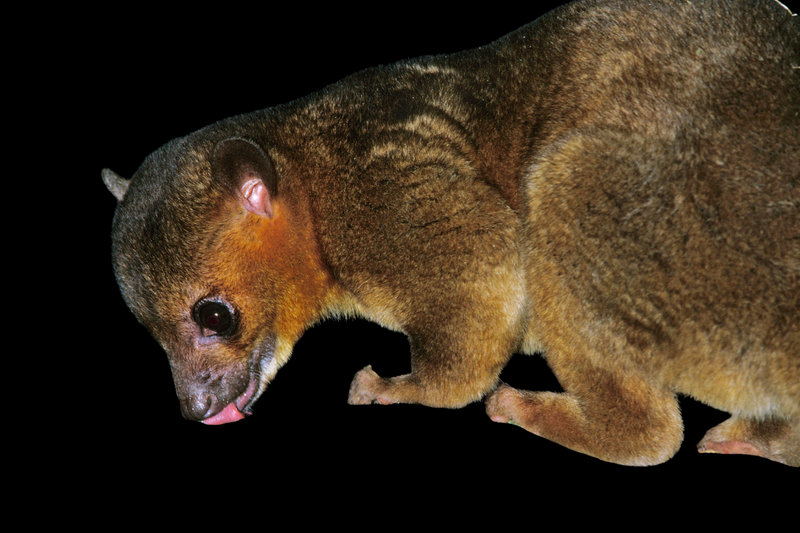
Tawny golden-brown above; paler below; large dark eyes; short rounded ears; fully prehensile tail used as a fifth limb
ADAPTATIONS
Fully prehensile tail grips branches allowing the animal to hang and feed with both hands free; long tongue extracts nectar from flowers; an important pollinator of tropical trees
🌿 Ecology
HABITAT
Tropical and subtropical evergreen forest; entirely arboreal and nocturnal; rarely descends to the ground
DIET
Omnivore
GEOGRAPHIC RANGE
Southern Mexico south through Central America to Bolivia and Brazil; in Mexico in Gulf lowland and Pacific slope forests
REPRODUCTION
Single young born after 112–118 day gestation; young clings to mother and is carried for months; fully prehensile tail developed early
DIET DETAILS
Fruit and nectar (primary diet); also flowers, honey, insects, eggs, and small vertebrates
⚠️ Threats & Conservation
PRIMARY THREATS
Habitat loss from deforestation; capture for the exotic pet trade; hunting for meat and fur
💡 Interesting Facts
1
The Kinkajou is one of very few carnivores to be primarily frugivorous; its long tongue (up to 13 cm) is specially adapted for nectar extraction, making it an important pollinator of tropical trees.
2
Despite being a member of the order Carnivora (related to raccoons), Kinkajous eat almost entirely fruit and nectar; they are one of the few non-primate mammals to have a fully prehensile tail.
🔭 Sighting Guide
📍 BEST PLACES TO SIGHT
Los Tuxtlas Biosphere Reserve near Catemaco, Veracruz, has Kinkajous visible by torch on night walks in primary forest
Palenque ruins and surrounding forest, Chiapas, have Kinkajous in the rainforest canopy on guided night tours
Montes Azules Biosphere Reserve in the Lacandon forest, Chiapas, has Kinkajous in undisturbed primary rainforest
🗓️ BEST TIME TO SIGHT
Year-round; night walks in Los Tuxtlas Biosphere Reserve, Veracruz, and Palenque area, Chiapas; eyes visible by torchlight in fruiting trees.
🎯 SIGHTING TIPS
Year-round but strictly nocturnal. Los Tuxtlas and Lacandon rainforest night walks offer the best chance; eyes reflect torchlight gold from the canopy.